Consular and Public Diplomacies Blog
  • Home
  • About
  • Interesting links
  • Contact
  • New Page
  • Home
  • About
  • Interesting links
  • Contact
  • New Page

The Origins  of Mexico´s Consular Diplomacy.

10/28/2020

0 Comments

 
Picture


In the last couple of days, I have been reading the spectacular book Antología Protección Consular a Mexicanos en los Estados Unidos 1849-1900, written by Ángela Moyano Pahissa.
 
After the author reviewed what I think must have been thousands of official documents and correspondence written by consuls of Mexico, the Mexican delegation in Washington, and the Ministry of Foreign Affairs, she divided the book into five chapters that deal with specific problems:
  1. Protection of Mexicans chased in the lost territories after the war.
  2. Protests for irregularities in the administration of justice to Mexicans.
  3. Protests for the occupation of land owned by Mexicans.
  4. Protests for violent acts against Mexicans.
  5. Protection of Mexicans or people from Mexican descendant that requested their repatriation to Mexico at the end of the 19th century.
 
In each, Moyano Pahissa included a selection of official documents that reflect the ideas, challenges, and solutions regarding these specific problems that resulted from the Mexico - U.S. War of 1846-1848 and the loss of half of its territory. It is incredible to read that some of them have not changed since then.
 
After reading the book, I now better understand the colossal influence that the annexation to the U.S. of the former Mexican territory had on the Mexicans living in those lands and the development of Mexico’s Consular Diplomacy.
 
From having to ratify their land ownership through a complicated and unfair process, to the need to decide in a year the nationality they wanted to have, Mexicans suffered greatly in the United States after 1848.
 
Besides, there was a direct attack not only against their culture but themselves. “Some historians state that in the decade from 1850 to 1860, Anglo-Americans lynched between three to four thousand Mexicans of a total population of ten thousand.”[i]
 
The systematic loss of property rights, in violation of Article VIII of the Guadalupe Hidalgo Treaty, had significant consequences for Mexicans. Even though property requirements to be able to vote were almost eliminated by then, payment of taxes was still a common requirement to vote, thus limiting their possibility to participate in politics and influence policies.
 
Therefore, Mexico’s government had to enhance the defense of its nationals’ rights north of the border, including the establishment of consular offices in places that before was its own country.
 
Back then, Consuls of Mexico had to respond to information requests by the President’s office about high profile cases reported in the press, when they involved Mexicans, either as victims or as perpetrators. They also presented complaints to U.S. authorities for the delay in court cases, the imposition of high cash bail amounts, or extended detention periods.
 
Mexican consular agents also had to be in constant communications with local and state authorities and the Mexican community, creating cooperation networks.  Border consulates had additional challenges like smuggling and attacks on Mexican communities by outlaws, and tribes.
 
If all this sounds similar to what Maaike Okano-Heijmans, a scholar of the Clingendael Institute, described as Consular Diplomacy in “Change in Consular Assistance and the Emergence of Consular Diplomacy,” is because it is!
 
The loss of property rights, the problem of questionable citizenship, the attack on Mexican culture and people, combined with widespread discrimination that Mexicans faced after 1848 in the lost territories, catapulted the government of Mexico to develop an incipient Consular Diplomacy, way before it was the norm across the world.[i]  

Some of the characteristics of today´s Mexican Consular Diplomacy developed during this period, such as:
  1. Registering Mexicans at the nearest consulate.
  2. Providing some legal advice and representation.
  3. Intervening in labor disputes.
  4. Striving to have consular offices and agents in places with high concentration of Mexicans.
  5. Adapting to the regional context.
  6. Collaborating with other actors.
  7. Participating in diplomatic issues at the local level.


[i] Moyano, Pahissa, Ángela, Antología Protección Consular a Mexicanos en los Estados Unidos 1849-1900, México, 1989, p. 113.
[i] Heijmans, Maaike and Melissen, Jan in Foreign Ministries and the Rising Challenge of Consular Affairs: Cinderella in the Limelight, Netherlands Institute of International Relations Clingendael, June 7, 2006, p. 4.
​

DISCLAIMER: All views expressed on this blog are that of the author and do not represent the opinions of any other authority, agency, organization, employer, or company.

0 Comments
Book review 5. “Consular Diplomacy in the face of U.S. demography and society in the 21st Century” ( Chp. 7) in La Diplomacia Consular Mexicana en tiempos de Trump.

10/22/2020

0 Comments

 
Picture

In the chapter “Consular Diplomacy in the face of U.S. demography and society in the 21st Century,” of the book La Diplomacia  Consular Mexicana en tiempo de Trump, Ambassador Juan Carlos Mendoza Sánchez explains that demography changes in the United States have resulted in the expansion of nativist movements and anti-immigrant sentiments amongst the white population.
 
He also details Trump´s changes to immigration policies and Mexico´s response to these challenges thru the implantation of an active and innovative Consular Diplomacy.
 
In the section titled “A new demography face that scares the WASP sector,” the Ambassador pinpoints June 18, 2003, as a milestone because it was the day when the Latino community in the U.S. reached 38.8 million turning into the first minority, overpassing the Afro-American population.[i] As a result, alarms rang amongst the conservative white people, and their response to this “invasion” was the creation and expansion of nativist and anti-immigrant policies.
 
Mendoza Sánchez details the history of anti-immigrant regulations in the U.S., starting from infamous California´s Proposition 187 of 1994 to Samuel Huntington´s book Who are we?[ii]
 
Latino population's fast growth in the U.S. resulted in being the majority group in 30 cities, so the Ambassador states that “it is not unfounded the white-population fears of becoming a minority in their own country [and that fear] have slowly developed into anti-immigrant sentiments, and policies to make the U.S. unattractive to those who live there.”[iii] Donald Trump`s presidency is just a new and more radical chapter in the U.S. immigration policy.
 
In the second part of the chapter, Ambassador Mendoza Sánchez explains that it was a radical change in the designation of undocumented migrants as threats to national security and public safety in two Executive Orders signed by the President.
 
He also details some of the multiple changes to immigration policies, guidelines, and enforcement operations to criminalize undocumented immigration, with a particular focus on Mexico´s border and the Latino population.[iv]
 
Another significant change was the end of enforcement priorities; thus, turning every single undocumented immigrant a target. Considering the existence of three million of mixed households meant the possibility of massive deportation that would have tremendous social consequences in the U.S. consequences of the new enforcement guidelines.[v]
 
In the section “New challenges for Mexican Consular Diplomacy,” Mendoza Sánchez emphasizes that immigration policy changes have a direct impact on Mexicans in the U.S. It presents one of the biggest challenges to Mexico´s Consular Diplomacy. He identifies ten of them, but here I only include six:
  • Delink the ideas that all undocumented migrants are Mexicans.
  • Preserve the alliances with authorities and politicians of sanctuary cities, to avoid any policy reversals.
  • Assist most vulnerable Mexicans living far from consular offices
  • Promote dual citizenship to those eligible.
  • Prepare those persons most at risk of being deported back to Mexico.
  • Strengthen community affairs programs.[vi]
 
The Ambassador highlights that there are more Mexican with immigration status than undocumented ones, for the first time in ages.[vii] This fact is unknown in the U.S. and contradicts the current anti-immigrant rhetoric that most Mexicans are undocumented.
 
He explains that undocumented persons tend to live in sanctuary cities, and the implementation of policies to limit resources to those authorities will affect them.[viii] Fortunately, it has not been occurred yet, mostly thru lawsuits.
 
Mendoza Sánchez writes that the Mexican community's geographical dispersion across the U.S. is one of the biggest challenges for consulates that cover large territories. The Mexican government's response was the establishment of the Mobile Consulate program that in the 21st century expanded into the Consulado sobre Ruedas (Consulate on Wheels) initiative.[ix] These activities were crucial for assisting vulnerable Mexicans after Trump´s inauguration.[x]
 
Additionally, he identifies that “developing synergies with pro-immigrant organizations, authorities, other countries’ consulates, and minority groups is one of the most effective activities for consulates under the current circumstances.”[xi]
 
Consular Diplomacy in action.
 
In response to the enhanced anti-immigrant context, the government of Mexico designed a Consular Diplomacy strategy that contained three main activities:
  1. Rights´ promotion and defense via the establishment of the Centros de Defensoria (Legal Defense Centers) in all consulates.
  2. Increase in personnel for documentation services and less red tape.
  3. Establishment of the Protección al Patrimonio Familiar (Family Wealth Protection) program of the Institute of Mexicans Abroad (IME).[xii]
 
He briefly explains the FAMEU program implemented in 2017 that had a 50 million dollar extraordinary budget.
 
He briefly mentions Local Repatriation Arrangements[xiii] that help Border consulates in the orderly and humanly repatriation of Mexican nationals.[xiv] These arrangements are a clear example of Maaike Okano-Heijmans´ Consular Diplomacy definition because they are “diplomatic” in nature but are negotiated, signed, and implemented locally. 
 
Then the Ambassador explains five different programs part of Mexico`s Consular Diplomacy:
a)Protection to Mexicans Abroad Innovations (Innovaciones en la proteccion a mexicanos).
  1. Family Wealth Protection program (Programa protección al patrimonio).
c)Assistance to Mexicans Abroad Unit (Módulo de Atención de Mexicanos en el Exterior)
d)Education Opportunities Window (Ventanilla de Oportunidades Educativas).
e)Promotion of preventive health among migrants (Promoción de la salud preventiva de los migrantes).
 
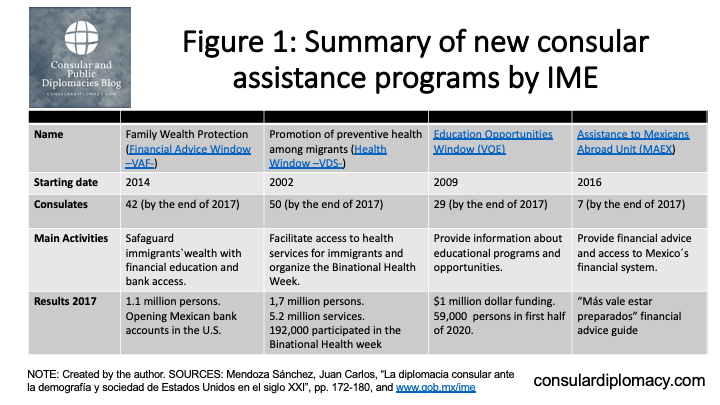
Even though Mendoza Sánchez briefly describes each program, I do not include them here. In Figure 1, located at the end of the post, you can find a summary. All of them are innovative consular undertakings of Mexico`s Consular Diplomacy, which some countries are replicating. Most of them are unique and lay outside the traditional consular services offered by most ministries of foreign affairs to their citizens abroad.
 
Four of the five programs highlighted by Ambassador Mendoza Sánchez are under the responsibilities of the Instituto de los Mexicanos en el Exterior (Institute of Mexicans Abroad).[xv]
 
I would like to share an extraordinary achievement of one of them: la Ventanilla de Salud or Health Window. In 2017, the American States Organization granted the “Inter-American Award on Innovation for Effective Public Management” to the Ministries of Foreign Affairs and Health of Mexico for the Health Window program in the Social Inclusion category. That year the Health Windows at the consular network provided 5.2 million services to 1.7 million people.[xvi]
 
Conclusion.
 
The chapter is interesting to read as the Ambassador summarizes the origins of the Anglo-American population's growing resentment against immigrants and minorities. He explains that “for the WASP community, the country´s demographic change is a challenge to their way of life, values, and identity; therefore, the hardening of U.S. immigration policies.”[xvii]
 
Mendoza Sánchez states that “to face this new reality, the Mexican Consular Diplomacy has engaged in the largest mobilization of its history with extraordinary programs… [with] the objectives of defending undocumented Mexican migrants´ rights and interests, and supporting them for better integration into their host communities.”[xviii]
 
He also describes some of Consular Diplomacy´s most-forward-looking programs developed to take care of the Mexican community's needs during difficult times.
 
The Ambassador recommends the following:
  1. that Mexican consuls continue with their personal engagements with their Mexican communities to know the people´s situation, assist, and, more importantly, build synergies and strategic alliances with non-government organizations, churches, community centers, schools, authorities, and other minority and immigrant groups.
  2. It is necessary to organize the Mexican community that has a voice, votes, and resources, in conjunction with the Mexican-American community and friends of Mexico, to be able to react to the attacks against Mexicans, disseminate the benefits of the bilateral relationship and the Mexican community`s contributions to the U.S. [xix]
 
In this chapter, Ambassador Mendoza Sánchez implicitly highlights one of the essential features of Mexico´s Consular Diplomacy: its adaptability and scalability. As seen in Figure 1, most of the programs described in the chapter started in one or two consulates. After having good results, they were slowly expanded into a country-wide operation at all 50 consulates, and sometimes in other countries with large Mexican populations.


[i] Mendoza Sánchez, Juan Carlos, “La diplomacia consular ante la demografía y la sociedad de Estados Unidos en el siglo XXI” in La Diplomacia Consular Mexicana en tiempos de Trump, Rafael Fernández de Castro (coord.), Mexico, 2018, p. 154.
[ii] Ibid. p. 154-155.
[iii] Ibid. p. 157-158.
[iv] Ibid. p. 159.
[v] Ibid. p. 161.
[vi] Ibid. 163.
[vii] Ibid. p. 164.
[viii] Ibid. p. 165.
[ix] Ibid. p. 165-166
[x] Ibid. p. 165
[xi] Ibid. p. 167.
[xii] Ibid. p. 168.
[xiii] The LRAs are signed by the Consulates of Mexico and DHS agencies. Border LRAs also include the participation of the National Migration Institute of Mexico. Find a public version of the 9 border LRAs here.
[xiv] Ibid. p. 169-170.
[xv] To learn more about Mexico`s government engagement with its diaspora, read the multiple publications of Alexandra Delano included in Google Scholar. See also Revista Mexicana de Política Exterior # 107 Comunidades Mexicanas en el Exterior, May-August 2016; de Cossío Díaz, Roger, et al., Mexicanos en el Exterior: Trayectoria y perspectivas 1990-2010, Instituto Matías Romero, 2010; Laglagaron, Laura, Protection through Integration: The Mexican Government Efforts to Aid Migrants in the United States, Migration Policy Institute, January 2010; and Rannveig Mendoza, Dovelyn and Kathleen Newland, Developing a Road Map for Engaging Diasporas in Development: A Handbook for Policymakers and Practitioners in Home and Host Countries, International Organization for Migration and Migration Policy Institute, 2012.
[xvi] Ibid. p. 179.
[xvii] Ibid. p. 180.
[xviii] Ibid. p. 180.
[xix] Ibid. p. 181.


DISCLAIMER: All views expressed on this blog are that of the author and do not represent the opinions of any other authority, agency, organization, employer or company.

Picture
0 Comments

BOOK REVIEW 4. “Mexico’s Integral Consular Management in the United States” (Chpt. 6) of Mexican Consular Diplomacy in Trump’s Era.

10/19/2020

0 Comments

 
Picture

 
In this post I analyze the chapter “Mexico´s Integral Consular Management in the United States” written by Francisco Javier Díaz de León and Víctor Peláez Millán of the book La Diplomacia Consular Mexicana en tiempos de Trump (Mexican Consular Diplomacy in Trump´s era).
 
In this chapter, Díaz de León and Peláez Millán evaluate Mexico’s comprehensive consular administration in the United States. They conclude that even though it has been able to face challenges and adapt to new circumstances, it lacks a long-term strategic vision.
 
The chapter is divided into three sections:
  1. Mexican Diaspora in the United States in Trump’s era: fear, hope, and support.
  2. Integral Consular Diplomacy Management.
  3. Areas of opportunities: Strategic Vision of Mexico’s comprehensive consular management.
 
  1. Mexican Diaspora in the United States in Trump’s era: fear, hope, and support.
 
In the first section, Díaz de León and Peláez Millán analyze the political context and the Mexican community’s conditions during Donald Trump’s presidency. They highlight the permanent fear experienced by Mexicans, particularly those undocumented, as a result of the aggressive Anti-immigrant and Anti-Mexican rhetoric and policies, at all levels, including some segments of U.S. society.
 
The authors identify the “legitimacy of bullying” against Mexicans across the nation, starting from the White House. Following the President’s lead, many local, county, and state authorities and politicians presented anti-immigrant actions to curb immigration.
 
Simultaneously, the authors indicate that “the Mexican diaspora is not alone; it has the support of a wide range of organizations and collaboration networks of civil rights and pro-immigration groups, legal representation, community development, [and] educational, health and financial services providers…”[i] This support is the result of the work of the 50 Mexican consulates that, since 1990, included community affairs activities to the traditional protection and documentation services.[ii]
 
Recognizing this new situation, in early 2017, the government of Mexico authorized more than 50 million dollars to implement the new strategy entitled Fortalecimiento para la Atención a Mexicanos en Estados Unidos (Strengthened Assistance to Mexicans in the United States), also referred to as FAMEU. Its objective was to support the Mexican community in the United States during these trying times.[iii]
 
Some of the strategy results in 2017 were the establishment of the Centros de Defensoría (Legal Defense Centers) that provided advice to more than 580,000 people and offered legal assistance and representation to 29,000 Mexicans.[iv]
 
Besides, the Centro de Información y Asistencia a Mexicanos (CIAM), Mexico’s 24 hours consular assistance calling center, received nearly 300,000 phone calls, and the Ventanilla de Asesoría Financiera (Financial Advice Desk) benefitted more than 124,000 Mexicans.[v]

2. Integral Consular Diplomacy Management. 

In the chapter’s second part, Díaz de León and Peláez Millán explain that the consulates of Mexico have a comprehensive work that includes three areas: protection, documentation services, and community affairs, also know as the consular tripod.
 
The authors incorporate to the concept of Mexico’s Consular Diplomacy additional objectives: improve the Mexican community’s well-being and promote their empowerment and inclusion to the host society.[vi] This is an extra element to the Consular Diplomacy ideas that Daniel Hernández Joseph and Reyna Torres Mendivil present in their book’s respective chapters.
 
Díaz de León and Peláez Millán explain that in recent years, the consular network executed an innovation process to improve the quality of its services.[vii] Some of the results were:
  1. The expansion of the Mobile Consulate program.
  2. Access to birth certificates issued in Mexico.
  3. Establishment of the Centros de Defensoría (Legal Defense Centers).
  4. Collaboration with civil rights organizations.
  5. Expansion of community empowerment activities.[viii]
 
Nevertheless, the authors recognize lagging areas, such as training, budget planning, computing equipment, and administrative systems’ reengineering.[ix]  
 
Díaz de León and Peláez Millán state that it is indispensable to identify ways to improve and maximize the use of available resources in addition to work with new partners. It will allow the consulates to respond to the immediate needs of the Mexican community while focusing on the strategic goal of promoting their empowerment and integration.[x]

3. Areas of opportunities: Strategic Vision of Mexico’s comprehensive consular management.  

Regarding areas of opportunities, the authors of the chapter distinguish the following
three:
a) Assuming a proactive role in the construction of a favorable ecosystem for the Mexican Diaspora.
b) Establishing a systematic outreach mechanism towards the 23 million Mexican-American.
c) Strengthening the consulate’s political activities that will add value to Mexico’s Consular Diplomacy.  

The critical element is to incorporate these prospects and the consular services improvement process into a long-term strategic vision that will allow the consulate to achieve the overall foreign policy objectives proactively.
 
Díaz de León and Peláez Millán conclude that the Mexican community appreciates and trusts the Mexican consular network.[xi] Also, Mexico’s Consular Diplomacy enjoys “the legitimacy and credibility to confront the current challenges and take advantage of the opportunities, regardless of U.S. immigration policies and activities.”[xii] Its most significant challenge is to develop a far-reaching plan to benefit the Mexican community north of the border.
 
This reading is a valuable contribution to the concept of the Consular Diplomacy of Mexico as the authors incorporate the Mexican Community’s empowerment as one of its goals. It also poses two crucial questions: a) How to maximize available resources assigned to its consular network? b) How to attract other relevant actors to collaborate in these efforts? Their answer could be the path for the much needed long-term strategic vision.
 
Besides, it is also significant because Díaz de León and Peláez Millán identify three areas of opportunity which could be implemented to continue the transformation of the consular services and programs offered by Mexican consulates in the U.S.
 
 
[i] Díaz de León, Francisco Javier and Peláez Millán, Victor, “Mexico´s Integral Consular Management in the United States” in La Diplomacia Consular Mexicana en tiempos de Trump, Rafael Fernández de Castro (coord.), Mexico, 2018, p. 131.
[ii] Ibid. p. 131.
[iii] Ibid.
[iv] Ibid. p. 132.
[v] Ibid. p. 133.
[vi] Ibid.
[vii] This is similar to other country´s consular services modernization initiatives, as referred by Heijmans, Maaike and Melissen, Jan, in Foreign Ministries and the Rising Challenge of Consular Affairs: Cinderella in the Limelight, Netherlands Institute of International Relations Clingendael, June 7, 2006, p. 7.
[viii] Ibid. p. 136.
[ix] Ibid. p. 137.
[x] Ibid. p. 137-138.
[xi] Ibid. p. 148.
[xii] Ibid. p. 147.


DISCLAIMER: All views expressed on this blog are that of the author and do not represent the opinions of any other authority, agency, organization, employer or company.
0 Comments

Book Review 3: “Consular Diplomacy:  A paradigm in the Mexico - U.S. relation” in Mexican Consular Diplomacy in Trump´s Era.

10/12/2020

0 Comments

 
Picture

This post is the review of chapter five of the book La Diplomacia Consular Mexicana en los tiempos de Trump  (Mexican Consular Diplomacy in Trump´s Era).  

In the chapter "Consular Diplomacy: A paradigm in the Mexico - U.S. relation" Ambassador Reyna Torres Mendivil writes that in recent years there has being a change in Mexico´s public discourse that recognizes consular activities as one of the critical elements of the country´s foreign policy.[i] 
 
She explains that consular services form part of Mexico´s Ministry of Foreign Affairs' main activities. Also gives examples such as the multiple bilateral consular groups that Mexico has and its active participation in multilateral fora like the Global Consular Forum or the Regional Conference on Migration.
 
By distinguishing the unique characteristics of Mexico´s Consular Diplomacy, Torres Mendivil aims to contribute to the evolution of the definition of the term.
 
She explains that the dividing lines between the diplomatic and consular activities have almost erased. The Ambassador revised the diplomatic functions of the Vienna Conventions on Diplomatic and Consular Relations and found out that of the 13 activities described for a consulate, three are similar to the ones of an Embassy.[ii] Then presents examples of the Mexican consulates´ diplomatic functions.[iii]
 
Torres Mendivil determines that Mexico´s Consular Diplomacy replicates, supports, and compliments at the local level the Embassy´s activities in Washington. And in some cases, these local collaborations later on become formal bilateral agreements.[iv]
 
The Ambassador explains that the need for protection and empowerment of the community pushed the consulates to build bridges with local authorities and even U.S. citizens and other non-traditional actors.[v]
 
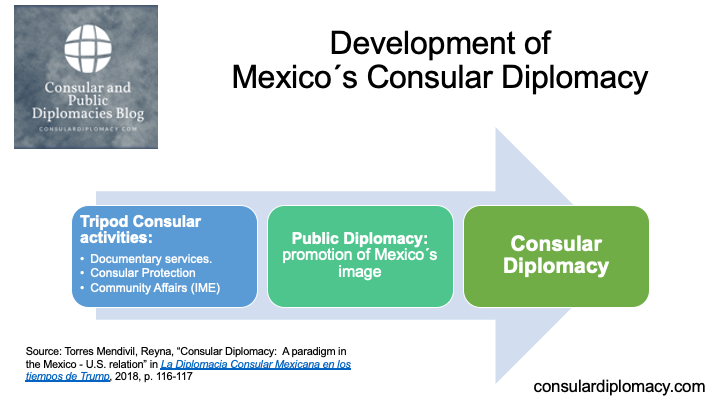
In addition to the tripod or regular consular activities,[vi] Torres Mendivil includes a fourth element of the consular action plan: Public Diplomacy. Its objective is the promotion of the image of Mexico. This new dimension is what explains the development from traditional consular assistance into a full-swing Consular Diplomacy.[vii]

​Here is a diagram of this evolution: 

Picture
The Ambassador explains how Mexico´s consular network implements the country´s Public Diplomacy. She gives different examples of foreign policy activities via Consular Diplomacy, including the collaboration with non-traditional actors such “as shelters for domestic violence victims, financial and credit organizations and religious institutions of all denominations.”[i].
 
Every week, there is consular presence in one or more media outlets, including scheduled radio and TV programs, where consular officers share relevant information to the Mexican community and the general public.
 
She explains that Mexico has exchange programs similar to those offered by the U.S. (International Visitor Leadership Program), Australia (International Media Visits), and Spain (Programa Internacional de Visitantes). The country developed the “Jornadas Informativas”[ii] , also knowns as IME´s conferences and organized the firsts visits to Mexico for Dreamers in 2014 and 2015. [iii]
 
Additionally, Torres Mendivil explains that the consular network makes enormous efforts to keep alive and visible traditional cultural celebrations. Even though it is hard to measure, she states that there was some influence by Mexico´s consular offices in the popularity of the Day of the Death in the U.S., that end up in the creation of the Disney movie “Coco”.[iv]
 
The political use of anti-immigrant sentiments is not new. It has compelled the consulates to be more strategic and resourceful to protect and empower the Mexican community in the U.S.
 
Ironically, the current administration heavy-handed anti-immigration actions have resulted in greater sympathies and a better understanding of the migrant community reality in the country.
 
At the end of the chapter, Ambassador Torres Mendivil proposes developing the consular network 2.0, which has to be visualized as a bilateral relationship at the local level (relación bilateral al nivel de cancha).[v] It will have to include outreach to multiple actors and local networks. In the end, this will result in a more positive image for Mexico and its diaspora. In the end, a solid consular diplomacy shields Mexico during challenging times, like the one we are living during the Trump administration. 
 
The chapter details Mexico´s Consular Diplomacy, adding new characteristics. More importantly, it proposes some ideas for developing a definition of the term, considering the country´s experience and practice.
 
Torres Mendivil briefly mentioned a topic that has developed thru time, which is the popularity of the Day of the Dead in the United States and its implications for Public Diplomacy. I think should be analyzed further. What do you think?
 
If we summarize the previous chapter by Ambassador Hernández Joseph together with the one written by Ambassador Torres Mendivil, three elements of Mexico´s Consular Diplomacy stand out:
  • It is part of the country´s Public Diplomacy to improve the nation´s deteriorated image amongst the U.S. public.
  • It focuses on the protection of Mexicans thru collaborations with local and state actors, including non-traditional ones.
  • It has helped weathered the current anti-immigrant sentiment and policies in the U.S.
 
These elements could be used to further elaborate a definition of Consular Diplomacy, from the perspective of Mexico´s practice.
 
In the next post, I will review chapter 6 of the book  La Diplomacia Consular Mexicana en los tiempos de Trump titled “Mexican Comprehensive Consular Management in the United States. Its evolution for the service of the diaspora and its strategic objectives.”


[i] Torres Mendivil, Reyna, “Consular Diplomacy:  A paradigm in the Mexico - U.S. relation” in La Diplomacia Consular Mexicana en tiempos de Trump, 2018, p. 109.
[ii] Torres Mendivil, “Consular Diplomacy:  A paradigm in the Mexico - U.S. relation”, p. 111.
[iii] Torres Mendivil, p. 113-115.
[iv] Torres Mendivil, p. 115.
[v] Ibid. p. 116.
[vi] For Mexico´s consular affairs, tripod or regular consular activities includes documentary services and consular protection for nationals, as well as community affairs activities organized under the umbrella of the Institute of Mexicans Abroad (IME).
[vii] Ibid. p. 117.
[i] Ibid. p. 119-120.
[ii] For a brief description in English of the Jornadas Informativas see ´Migrant-Focus Conferences` on page 19 of the paper Protection through Integration: The Mexican Government's Efforts to Aid Migrants in the United States.
[iii] Ibid. p. 119.
[iv] Ibid. p. 120.
[v] Ibid. p. 123.
 
DISCLAIMER: All views expressed on this blog are that of the author and do not represent the opinions of any other authority, agency, organization, employer or company


0 Comments

Book Review 2: “Lessons of consular protection for consular diplomacy” (Chp. 4)  in Mexican Consular Diplomacy in Trump´s Era

10/5/2020

0 Comments

 
Picture
In this chapter of the book La Diplomacia Consular Mexicana en tiempos de Trump (Mexican Consular Diplomacy in Trump´s Era), Ambassador Daniel Hernández Joseph makes an excellent overview of Mexico’s diplomacy confronting the ever-changing immigration issue in the United States. He identifies elements, as he calls them, that worked well in the past, and some that they did not, that could be used in responding to the challenge that Trump´s administration presents.
 
Hernández Joseph does a brilliant job of synthesizing the most critical periods in the history of Mexico-U.S. migration, which includes Mexico´s most relevant actions. He divides the phases as follow:
  • 1821-1848;
  • 1848-1920;
  • 1920-1942;
  • 1942-1964;
  • 1964-1986;
  • 1986-1995;
  • 2000-2001; 
  • 2001-2017;
  • 2017-Today[i]
 
By focusing on Mexico’s consular protection of its nationals in the U.S., Ambassador Hernández Joseph highlights the attributes of the rising Consular Diplomacy: its relevance to the country´s overall foreign policy goals and its increase visibility. Therefore, this chapter is valuable as it presents the evolution of the concept of Mexico´s Consular Diplomacy.
 
He explains some of Mexico´s challenges regarding immigration policies and attitudes in the United States, such as the 1930s massive deportation of Mexicans, and the period of bilateral agreements like the Bracero program, that ran from 1942 until 1964. The Ambassador acknowledges the value of the two-way dialogue and the importance of agreements, even if there is no full compliance.
 
Hernández Joseph also recognizes the government of Mexico´s efforts  to promote the empowerment of the Mexican community north of the border, indicating that it is one of the critical elements of its Consular Diplomacy.
 
Ambassador Hernández Joseph also acknowledges that an area where Mexico has not succeeded is in improving its image in the United States; notably, it has failed in attaining the recognition by the U.S. society of the contributions made by the Mexican community to the country´s wellbeing.[ii]
 
From Mexico´s previous experiences, the Ambassador identifies four elements that helped the country defend its interests in the United States:
  1. Self-management, which focuses on the empowerment of the local community.
  2. Bilaterality, meaning the importance of maintaining a continuous dialogue with U.S. authorities in most aspects related to migration.
  3. Consular leadership, to create trust and strengthen the bonds with the Mexican community.
  4. Interagency collaboration, which creates a unified response to the challenges and demonstrates the compromise of the government toward the Mexican community abroad.[iii] 
 
I agree that these four lessons are essential tools that could be displayed to confront the current anti-immigrant movement in the United States, as part of Mexico´s Consular Diplomacy.
 
To conclude, Ambassador Hernández Joseph states that in “…today´s environment, the biggest challenge is to make that the bilateral dialogue effectively results in benefits and protection of the interests of the migrants.”[iv]
 
As we can see, Mexico´s practice of Consular Diplomacy is broader and deeper than the recognized definition of the term described by Maaike Okano-Heijmans.[v] In this case, as a country that has a large population living overseas, migration bilateral negotiations and issues are the core of its Consular Diplomacy efforts. And it is essential to remember that the agreements and actions have to be brought to the operational level by each consulate.
 
It is remarkable to realize that some of these activities that are now considered Consular Diplomacy were already being implemented by the consulates of Mexico in the United States a century ago. So we need a reevaluation of these activities in light of this new academic framework.
 
An exciting twist about Consular Diplomacy that needs to be further explored is that while the center of the actions is to assist and protect its own citizens abroad, most of the consular activities are undertaken via partnerships with local organizations, authorities, and citizens of the host country. So here we have a case of Public Diplomacy with the foreign policy objective of helping its nationals overseas, with the support of local actors.
 
I recommend this chapter because it presents a summary of Mexico´s consular protection activities in the United States and identifies lessons for today´s Consular Diplomacy challenges.
 
 
[i] Hernández Joseph, Daniel, “Lecciones de la protección consular para la diplomacia consular” in La Diplomacia Consular Mexicana en tiempos de Trump, 2018 p. 92-95.
[ii] Hernández Joseph, Daniel, “Lecciones”, 2018 p. 103.
[iii] Hernández Joseph, Daniel, Ibid. p. 103-105.
[iv] Hernández Joseph, Daniel, Ibid. p. 105.
[v] See previous post on Consular Diplomacy LINK and Okano-Heijmans, Maaike, “Change in Consular Assistance and the Emergence of Consular Diplomacy”, Netherlands Institute of International Relations ´Clingendael´, February 2010, p.1.


DISCLAIMER: All views expressed on this blog are that of the author and do not represent the opinions of any other authority, agency, organization, employer, or company.

0 Comments

Book Review 1: Mexican Consular Diplomacy in Trump´s Era (Prologue and Introduction).

10/1/2020

0 Comments

 
Picture


Mexico´s Consular Diplomacy has been developing slowly since the day that the country lost half of its land to the United States in 1848.[i] As a result, many of the Mexicans who stayed in the new U.S. territory needed consular assistance from the government to protect their rights.[ii]
 
Since then, it has had to deal with different crises, from the mass deportation of even U.S. citizens from Mexican descent during the Great Depression and the operation “Wetback” of 1954, as well as from the immigration reform of the mid-1980s which granted status to millions of Mexicans, to September 11, 2001, and the current anti-immigrant, anti-Mexicans sentiments headed by the U.S. President.
 
However, little has been written about it, particularly in English. Only two studies have been published about Mexican Consular Diplomacy, both in Spanish. First, the Revista Mexicana de Política Exterior No. 101 titled Consular Diplomacy: Service Calling and Strategic instrument of Foreign Policy in 2014; and second, the 2018 book La Diplomacia Consular Mexicana en tiempos de Trump, (Mexican Consular Diplomacy in Trump´s Era).
 
As the coordinator of the book, Rafael Fernández de Castro,[iii] clearly states, “This book could fill the existing void in the scholarly literature about the concept of Consular Diplomacy. Indeed there is no bibliography related [to the topic] as it is a concept that has been developing thru a unique practice: the consular activity displayed by Mexico in the United States.”[iv]
 
To expand the audience of the book and the knowledge about Mexican Consular Diplomacy, in the coming weeks, I will be posting a review of most of the chapters of the book.
 
But before going further, let´s contextualize the moment of the publication, as it is very focused on the current situation in the United States with the Presidency of Donald Trump.
 
On June 15, 2015, the well-known businessman Donald Trump announced he was running for President in the 2016 elections. In his speech, he accused Mexico of “bringing their worst people,” including criminals and rapists, and promise to build a “great, great wall on our southern border, and I will make Mexico pay for that wall.”[v]
 
Against all the odds, Trump was not only the Republican Party presidential candidate, but he won the presidency thru the Electoral College on November 8, 2016. In addition to his offensive language towards Mexico and Mexicans, during the campaign threatened to suspend the North America Free Trade Agreement (NAFTA) and he pushed for a very aggressive anti-immigrant policy, including regular immigrants, not just the undocumented ones.
 
After his inauguration in January 2017, one of Trump´s first acts was issuing several Executive Orders, mainly focused on immigration issues.[vi] It has been said that Trump´s speeches and actions are one of the reasons for the increase in hate incidents and crimes across the country even before he took office.[vii]
 
So, let’s say that the implications for a Trump presidency were a clear and present danger for Mexico, particularly for the millions of Mexicans who make the United States their home, regardless of their immigration status.
 
After Trump´s election, the group of people that originally met in August 2016 to review the Institute for Mexicans Abroad, was invited to write a chapter for the book.
 
Prologue: The evolution of migration and its effect on consular work
 
In the book´s prologue, the then Under Secretary for North American Affairs, Carlos M. Sada, the only person in Mexico’s modern history to head the three biggest Consulates and the Embassy in the U.S., describes that the growth of the Mexican community north of the border pushed the government of Mexico to intensify its consular protection and documentation[viii] activities, during the latter part of the 20th Century. And later on, at the onset of the new millennium,[ix] to expand them to facilitate their integration to the host country.[x]
 
Sada explains that at the beginning, Consular Diplomacy “was a necessary tool rather than a deliberate strategy.”[xi] And it entailed “expanding the reach of consular activities by the Consulates with the objective of offering better and more options, not only for an enhanced consular protection but as defense, response, and visibility mechanisms.”[xii]
 
The Undersecretary also describes the consular rapprochement with state and local actors with influence for the benefit of the Mexican community, that in some cases, developed in the creation of several non-governmental organizations such as Cien Amigos in Sacramento, Mexico Innova in Los Angeles, or Aguila Alliance in Austin, Texas.
 
The prologue also includes a brief description of what the consulates have done after the inauguration of President Trump, emphasizing the partnership developed between the consulates and all types of authorities, companies, trade and non-profit organizations, lawyers, and the civil society that recognize the valuable relationship with Mexico.
 
Introduction: the Concept of Consular Diplomacy and the organization of the book.
 
In the introduction, Fernández de Castro details the origins of the book and gives a general overview of its content. He indicates that Diplomacia Consular Mexicana is divided into two sections. The first part focuses on three topics: the development of the ´alt-right` movement in the U.S., the emergence of ´fake news´, and Trump`s relationship with the press and the cooperation and conflict at the border. I will not review these chapters at this time.
 
The second part of the book has ten chapters, which were written by mostly Mexican diplomats who have extensive consular experience in the United States. Here is a list of the chapters and their authors.
 
         4. Lessons from consular protection for consular diplomacy / Daniel Hernández Joseph.

​     5. Consular Diplomacy:  A paradigm in the Mexico - U.S. relation / Reyna Torres Mendivil.

     6. Mexico`s Integral Consular Management in the United States. Its evolution for the service of the diaspora and its strategic objectives / Francisco Javier Díaz de León and Víctor Peláez Millán.

           7. Consular Diplomacy in the face of U.S. demography and society in the 21st Century / Juan Carlos Mendoza Sánchez.

         8. The synergies with other communities: the case of Tricamex / Jorge A. Schiavon and Guillermo Ordorica R.

      9. Consular diplomacy and outreach to strategic partners / Vanessa Calva Ruiz.

​  10. Mexican consular diplomacy and the risks of administrative hydrocephaly / José Octavio Tripp.​

     11. Staying at the forefront: the challenge of the consulates of Mexico in the United States / Rafael Laveaga Rendón.

     12. The meaning of a special relation: Mexico´s relationship with Texas in the light of California´s experience / Carlos González Gutiérrez.

​     13. The role of Consular Diplomacy in a transborder context: The case of CaliBaja / Marcela Celorio.
* As mentioned, the first section of the book with three chapters won’t be reviewed at this time. This is why the list starts with chapter 4.

Also, he briefly analyses the development of Mexico´s Consular Diplomacy. He explains that “…in the last 25 years, the consulates have deployed a series of activities that resemble that of a regional embassy: in addition to the traditional [consular] tripod (consular protection, documentation and communitarian work) [they] develop economic promotion, political lobbying and what is known as Public Diplomacy…meaning thru different actions in the media and cultural promotion [consulates] work to improve the image of Mexico.”[xiii]
 
He concludes that even though “Consular Diplomacy resembles that of diplomatic endeavor… it still maintains a special affinity with Mexicans in the United States.”[xiv]
 
Overall, the prologue and the introduction set the stage for the experiences that seasoned Mexican diplomats share in the second part of the book. However, there is no review of scholarly literature about Consular Diplomacy as well as lacks any discussion of theoretical approaches on the subject.
 
What the book does undoubtedly is to share with the reader the wide variety of initiatives and activities undertaken by consulates, some unique and localized, and others instrumented throughout the consular network. With these examples, one could eventually develop a conceptual basis for consular Diplomacy as practiced by Mexico.
 
Now let´s move on to the chapter written by Ambassador Hernández Joseph, titled “Lesson from consular protection for consular diplomacy”, which I will review in the next post.

[i] Hernández Joseph, Daniel, Protección Consular Mexicana, México, 2015, p. 49-50.
[ii] Hernández Joseph, Daniel, “Lecciones de la protección consular para la diplomacia consular” in La Diplomacia Consular Mexicana en tiempos de Trump, 2018 p. 94-95.
[iii] He is a well-known Mexican foreign policy analyst and currently is the director of the Center for U.S.-Mexican Studies of the University of California, San Diego.
[iv] Translated by the author. Fernández de Castro, Rafael ,“Introducción” in La Diplomacia Consular Mexicana en tiempos de Trump, Mexico 2018, p. 17.
[v] Neate, Rupert, “Donald Trump announces US presidential run with eccentric speech” in The Guardian, June 16, 2015.
[vi] To see a comprehensive list of changes made to immigration laws and policies since the start of Trump´s presidency see Pierce, Sarah and Bolter, Jessica Dismantling and Reconstructing the U.S. Immigration System: A Catalog of Changes under the Trump Presidency by the Migration Policy Institute, July 2020.
[vii] See for example Hassan, Adeel, “Hate-Crime Violence Hits 16-Year High, F.B.I. Reports”, in The New York Times, November 12, 2019, and Folley, Aris, “Hate crimes rose by 226 percent in the countries where Trump hosted campaign rallies in 2016: study” in The Hill, March 23, 2019.
[viii] Consular documentation or documentary are services that the consulate provides, such as issuing passports, visas, birth registrations and powers of attorney, as well as authentication of documents.
[ix] In 2003 the Institute of Mexicans Abroad was established and that greatly expanded the community affairs activities of the consulates, including the establishment of “Ventanillas de Salud” (Health Windows), the inclusion of educational programs and the use of remittances for the development of local communities. To learn more about the government of Mexico´s engagement with its diaspora, read some of the multiple publications of Alexandra Delano included in Google Scholar. See also Revista Mexicana de Política Exterior # 107 Comunidades Mexicanas en el Exterior, May-August 2016; de Cossío Díaz, Roger, et. al., Mexicanos en el Exterior: Trayectoria y perspectivas 1990-2010, Instituto Matías Romero, 2010 and Laglagaron, Laura, Protection through Integration: The Mexican Government Efforts to Aid Migrants in the United States, Migration Policy Institute, January 2010.
[x] Sada, Carlos M., “Prólogo: La evolución de la migración y su efecto en el trabajo consular” in La Diplomacia Consular Mexicana en tiempos de Trump, Mexico 2018, p. 9-10.
[xi] Sada, Carlos M., “Prólogo” p. 11.
[xii] Ibid.
[xiii] Fernández de Castro, Rafael, “Introducción: El concepto de Diplomacia Consular y la organización del libro” in La Diplomacia Consular Mexicana en tiempos de Trump, Mexico 2018, p. 18.
[xiv] Fernández de Castro, Rafael, “Introducción”, p. 19.


DISCLAIMER: All views expressed on this blog are that of the author and do not represent the opinions of any other authority, agency, organization, employer or company.


0 Comments

Consular Diplomacy during the COVID-19 Pandemic

9/10/2020

0 Comments

 
Picture
“… the 2020 coronavirus crisis has made assistance to nationals in en masse crises the most visible 21st century function of ministries of foreign affairs (MFAs).”[i]
 
If people have questioned the existence of Consular Diplomacy, the pandemic caused by COVID-19 has been a wakeup call. Almost all countries across the globe faced the challenge of bringing home citizens that were stuck overseas as most of the world closed its border for traveling.  
 
Because of its staggering size, even the wealthiest countries were not prepared for the scale of the consular assistance demanded as a result of the pandemic.
 
Consular officials around the world have to negotiate not only with local and central authorities but also airlines, tour operators, and sometimes even individual hotels or Airbnb hosts to assist their citizens. All these while receiving an unprecedented demand for help, via telephone, but more often, social media from abroad and at home.
 
There is a shared understanding that the most developed plans to provide consular assistance in a crisis fell short as the COVID-19 pandemic presented embassies, consular offices, and foreign ministries with enormous demand from all across the world, almost at the exact time.
 
At this trying times, consular officials need to be recognized for dealing, the best they could, with this crisis of global dimensions.
 
Here you can find some of the responses to the need to repatriate hundreds of thousands, if not millions of citizens that were stranded overseas as country after country closed their borders to quell the pandemic.
 
The Lowly Institute of Australia stated that “In April 2020, the scale of the consular crisis has become crystal clear. Of Australia’s one million-strong diaspora and several hundred thousand short-term trip-makers, 200,000 have returned home in the past three weeks.
 
The United Kingdom reported spending £75 million to repatriate 300,000 of its citizens abroad. The United States has repatriated 43,000 Americans from 78 countries since late January. The list goes on.”[ii]
 
In Canada, the “Foreign Affairs Minister François-Philippe Champagne has taken some unconventional means to bring home thousands of Canadians stranded abroad by the COVID-19 pandemic, from securing landing rights for planes over text message to directly negotiating flight fares with airline CEOs.”[iii] So, by the end of May, the Canadian government was able to repatriate close to 40,000 people from 100 countries on 356 flights.[iv]
 
Even private companies, in this case, Sunwing Airlines, were assisting in the repatriation efforts, by giving away without charge empty seats in their planes to nearly 5,000 that were not customers of the airline. In total, the airline stated that it brought back over 60,000 Canadians stranded abroad.
 
Besides working on bringing back home its citizens, Global Affairs Canada convened the Ministerial Coordination Group on COVID-19, formed by 15 countries, which announced a Declaration on Maintaining Essential Global Links amid the pandemic on April 17, 2020.
 
The U.S. State Department stated that by April 1, 2020, “has helped more than 30,000 Americans stranded in 60-plus countries board 375 U.S.-bond flights.[v] However, some of its citizens complained about its slow reaction compared with other countries such as Germany.  In response, a State Department spokesperson commented that “the State has never undertaken an evacuation effort of such geographic breadth, scale, and complexity in its 230-year history.”[vi]
 
Regardless of the complaints, on June 12, 2020, the U.S. Senate unanimously approved a resolution “commending career professionals at the Department of State for their extensive efforts to repatriate United States citizens and legal permanent residents during the COVID-19 pandemic”.[vii]
 
The Ministry of Foreign Affairs of Mexico has also worked on the repatriation of nationals overseas. It publishes on social media a daily update on the number of Mexicans safely returned home and nearly weekly statistics of Mexicans who unfortunately had COVID-19, including the almost 2,173 who died abroad. By July 29, embassies and consulates of Mexico around the world assisted in the repatriation of nearly 16,500 Mexicans stranded abroad. 
 
In an unprecedented consular action, on July 11, 2020, a Mexican Air force airplane repatriated 245 urns with the remains of Mexicans that died from COVID-19 in the area of responsibility of the Consulate General of Mexico in New York City.  
 
By sheer volume, 1.3 million persons repatriated via commercial flights since the beginning of the pandemic, the Foreign and Commonwealth Office of the United Kingdom had one of the biggest challenges. Meanwhile, the European Union estimates it helped with the repatriation of 590,000 of its citizens abroad.
 
Every country across the globe had to assist their nationals, and sometimes citizens of other countries, during the pandemic.
 
We just have to recognize their commitment and public service in these challenging times. Thank you all consular officials around the world!  
 
Before closing, I want to bring to your attention a fascinating research paper by a great Consular Diplomacy scholar, Jan Melissen. In it, he describes that a more significant challenge for ministries of foreign affairs than provide consular assistance to their national abroad is how to communicate with them to change behaviors successfully. The paper has two versions: the short one posted in the Devpolicyblog, and the more scholarly work in Asia and the Pacific Policy Studies Journal.
 
 
[i] Melissen, Jan, “Nationals in crisis and diplomacy´s domestic communication challenge” in DevpolicyBlog, April 27, 2020.
[ii] Oliver, Alex, “Post-COVID-19 diplomacies will be refinanced”, in the World after COVID-19 by the Lowly Institute
[iii] Carbert, Michele “Minister takes unconventional diplomatic steps to repatriate stranded Canadians amid COVID-19” in the Globe and Mail, April 14, 2020.
[iv] Harris, Kathleen, “Government operation to bring home pandemic-stranded Canadians almost complete, says MP” in CBC, May 22, 2020.
[v] Williams, Abigail and Li, David K. “State Department warns Americans stranded overseas that time is running out” in NBC News, April 1st, 2020.
[vi] Cachero, Paulina, “Americans stranded abroad complain that other countries are evacuating their citizens way faster than the US government is” in The Insider, April 3, 2020.
[vii] S.Res.567 - A resolution commending career professionals at the Department of State for their extensive efforts to repatriate United States citizens and legal permanent residents during the COVID-19 pandemic, United States Senate, 116th Congress, June 11, 2020.

 
DISCLAIMER: All views expressed on this blog are that of the author and do not represent the opinions of any other authority, agency, organization, employer or company.
0 Comments

A New Tool for Foreign Policy: Consular Diplomacy

9/7/2020

1 Comment

 
Picture

As I continue to explore the three main concepts of the blog, it is the turn for Consular Diplomacy.
 
As a diplomat, one thing that strikes me about the idea of Consular Diplomacy is that it has been part of the “traditional” Diplomacy for a long time. For most of history, most countries’ first foreign posts where consulates and not embassies.[i]  Consular officials existed before the arrival of permanent representatives and ambassadors. In many states, such as Mexico, a joint diplomatic and consular corps forms its Foreign Service, not one or the other.
 
So why now we have Consular Diplomacy? Is it not part of traditional Diplomacy?
 
Maaike Okano-Heijmans, a scholar of the Clingendael Institute, published the paper “Change in Consular Assistance and the Emergence of Consular Diplomacy” in February 2010. In it, she defines Consular Diplomacy as “international negotiation on a consular (legal) framework and individual consular cases that attract substantial attention from the media, public and politicians.”[ii]
 
She argues that this is a new development, starting at the end of the 1990s. It is not something that happened before, or that has always occurred.[iii] These changes came as a result of the increase of globalization, the growing power of the media, and heightened expectations by nationals who travel overseas.[iv]
 
Okano-Heijmans describes the changes that occurred, so “the government´s responsibility to protect its citizens (abroad) is no longer just a consular matter, but increasingly a diplomatic concern.”[v] Then she presents a theoretical background to better explain the existence of Consular Diplomacy as a new field of study as well as the relevance of negotiations of consular issues at the bilateral and multilateral levels.
 
In general terms, she presents two forms of Consular Diplomacy:
  1. “Governments attach increasing important to and are becoming more involved in consular affairs at the practical as well as policy levels”[vi] that entails from the negotiation of agreements about consular affairs to the exchange of best consular practices and cooperation on the ground.
  2. “immediate consular assistance that is under close scrutiny from the media and politicians…”[vii], in specific cases or crises, that could confront the national interest of the State versus the individual´s consular protection case.
 
Later, I will review additional forms of Consular Diplomacy.
 
A significant development in Consular Diplomacy was the establishment of the Global Consular Forum in September 2013, after a meeting in Wilton Park, Great Britain. A report of the meeting was published. Like-minded countries decided that the Vienna Convention on Consular Affairs of 1963 was lagging behind the consular practice in the 21st century; therefore, they agree to create this Forum.
 
Since then, there have been two more meetings in Cuernavaca, Mexico, in May 2015 (report) and Seoul, Korea, in October 2016 (summary).  And the work of the Forum has continued since then.
 
The Forum in itself is a significant development toward the consolidation of Consular Diplomacy as a new area of study, as foreign ministries from all continents, in an informal multilateral platform, gather to
  • “…exchange experiences, tools, best practices and lessons-learned in consular services, emergency management and crisis response
  • …find solutions to various international issues that can negatively impact consular service delivery, access, safe travel and protection of nationals in foreign countries.
  • …explore new ways and opportunities to improve cross-border consular work and cooperation, including the development of various collaboration initiatives… (as well as).
  • …drive forward the international consular agenda, increase the profile of consular affairs globally and improve conditions for safe travel and delivery of consular services.”[viii]
 
If these actions are not Consular Diplomacy, I do not know then what would be it.
 
An exciting development is the existence of the course Consular and Diaspora Diplomacy that the DiploFoundation offers as part of its curricula.
 
In the next post, I will discuss about Consular Diplomacy during the COVID-19 pandemic, further proof of its existence.
 
You can also read additional posts about consular diplomacy, such as:
  • Global Consular Forum: Consular diplomacy in the 21st Century
  • Consular diplomacy: Cinderella no more, but not yet a princess
  • Recent studies on consular diplomacy: reevaluating the consular institution
  • Rethinking consular diplomacy
  • Mexico´s public-consular diplomacy
  • New publications on consular diplomacy 

[i] For a brief overview of the confluence of consular affairs and diplomacy see Jestin, Mathieu, “The Affirmation of “Consular Diplomacy” during the modern period”, in Encyclopédie pour un histoire nouvelle de l´Europe, online, November 10, 2017.
[ii] Okano-Heijmans, Maaike, “Change in Consular Assistance and the Emergence of Consular Diplomacy”, Netherlands Institute of International Relations ´Clingendael´, February 2010, p.1 .
[iii] Idem.
[iv] Idem, p. 2.
[v] Idem, p. 8.
[vi] Idem, p. 23.
[vii] Idem.
[viii] Global Consular Forum, “Mission and Overview”


DISCLAIMER: All views expressed on this blog are that of the author and do not represent the opinions of any other authority, agency, organization, employer or company.
1 Comment

Why a blog about Consular and Public Diplomacies?

9/1/2020

0 Comments

 
Picture

ST​

Much has been written about the end of diplomacy and the surge of the new diplomacy, particularly in the 21st Century international affairs and foreign policy debate.
 
With the arrival of faster communications and transport as well as the popularity of summit diplomacy, there was a discussion about the end of diplomacy as we have known it.
 
However, even today, with even faster changes in the digital arena, time and again, diplomacy and diplomats have been able to survive, adapt, and remain relevant for the foreign policy of the countries around the world, large or small.
 
The latter does not mean that diplomacy and how countries instrument them have not changed with time.  As part of the new diplomacy, governments are engaging directly with the citizens of other nations, with a specific purpose, knows as Public Diplomacy.
 
Additionally, even though consular issues are intrinsically part of a country´s international affairs, just recently, it has been thrust to the main stage of a nation´s foreign policy, developing into Consular Diplomacy. This is particularly true as more demanding citizens travel, migrate and live abroad, expecting consular assistance from their government. And things are much more complicated now with dual or multiple citizenships.
 
Last but now least, Gastrodiplomacy is a term coined in 2002 by The Economist to refer to a country´s efforts “to conduct cultural diplomacy through the promotion of their cuisine”[i] Since then, there has been some studies and articles about it, including an exclusive issue of the Public Diplomacy magazine in 2014.
 
Are all these real types of diplomacies that foreign ministries across the world have at their disposal to achieve foreign policy and national interest goals? Or are they just ways to instrument some actions but are not a separate and particular way to do international affairs? These are some of the questions that I will discuss in this blog.

To learn more about the discussion whether Consular, Public and Gastronomic Diplomacies are the real deal or imposters, you can read the following posts:

"New" Diplomatic Tools: Imposter Diplomacy or the Real Deal? and
Consular Diplomacy: Cinderella no more, but not yet a princess.


​
[i] Rockower, Paul “Recipes for gastrodiplomacy” in Place Branding and Public Diplomacy, 2012, Vol. 8, No. 3, p. 235.

DISCLAIMER: All views expressed on this blog are that of the author and do not represent the opinions of any other authority, agency, organization, employer or company.
 

0 Comments
Forward>>

    Rodrigo Márquez Lartigue 

    Diplomat interested in the development of Consular and Public Diplomacies. 

    Archives

    September 2024
    May 2024
    April 2024
    January 2024
    December 2023
    November 2023
    October 2023
    September 2023
    August 2023
    July 2023
    June 2023
    May 2023
    April 2023
    March 2023
    February 2023
    January 2023
    December 2022
    August 2022
    May 2022
    March 2022
    January 2022
    December 2021
    September 2021
    August 2021
    July 2021
    April 2021
    March 2021
    February 2021
    January 2021
    December 2020
    November 2020
    October 2020
    September 2020

    Categories

    All
    Artificial Intelligence
    Consular Affairs
    Consular Care Protocols
    Consular Diplomacy
    Corporate Diplomacy
    Cultural Diplomacy
    Denmark
    Digital Diplomacy
    Diplomacy
    Gastrodiplomacy
    Global Consular Forum
    Global Politics
    Global South
    Health Desks (VDS)
    Labor Rights Week
    Mexico
    Nation Brand
    Nation-Brand
    Paradiplomacy
    Public Consular Diplomacy
    Public-consular Diplomacy
    Public Diplomacy
    Tech Diplomacy
    TRICAMEX
    United Kingdom
    United States
    VAIM

    View my profile on LinkedIn
Proudly powered by Weebly